
Sunday Business Post: The mindful maverick: Inside entrepreneur Neil McDermott’s €4m wellness retreat in Laois
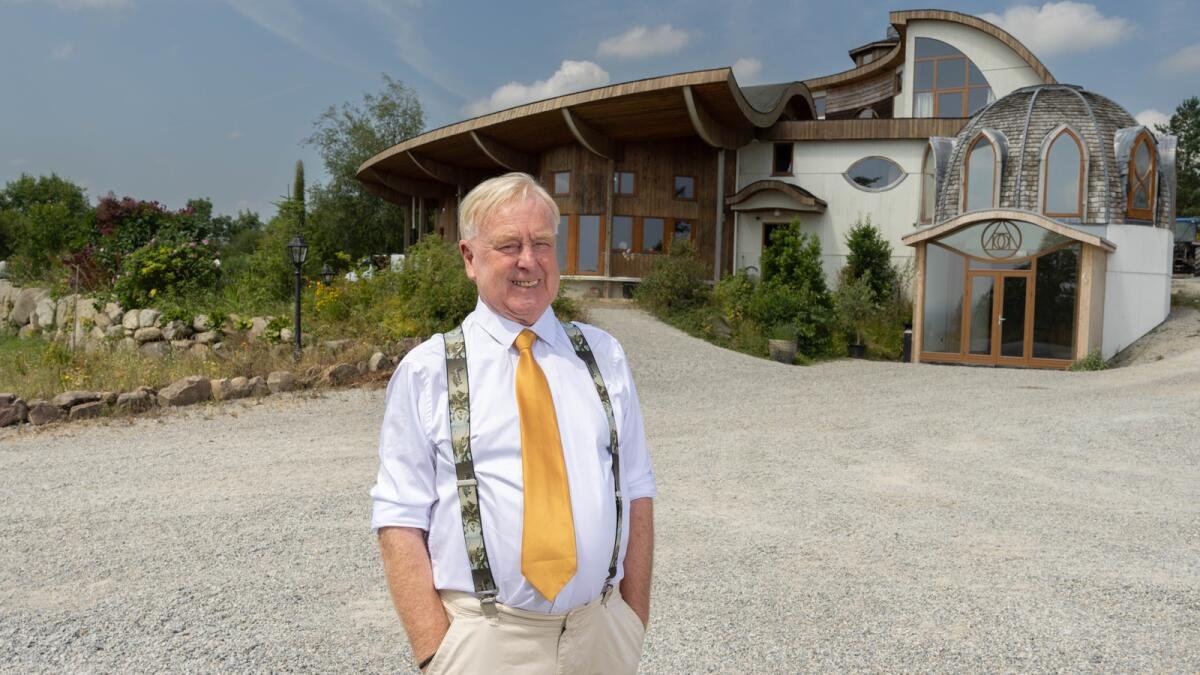
Neil McDermott: ‘When I was a 40-year-old farmer travelling to an ashram in India, people thought I was mad.’ Picture: Barry Cronin
It feels fitting for Neil McDermott to slip off his shoes at the front door of his rejuvenation and wellness centre, Arunachala in Co Laois, only to reveal a pair of bright blue socks dotted with cheery white sheep and one, even cheerier, black sheep.
The 75-year-old Meath man has reinvented himself aplenty over his lifetime, from farmer to machinery trader and building contractor. But one constant throughout is that he is nonconformist by nature; the sheep who decidedly does not follow the flock.
His latest €4 million venture is the marvel that affirms this. It is, McDermott says as he sits on edge of a guest room couch overlooking the expansive 30-acre site, “my final mad reincarnation”.
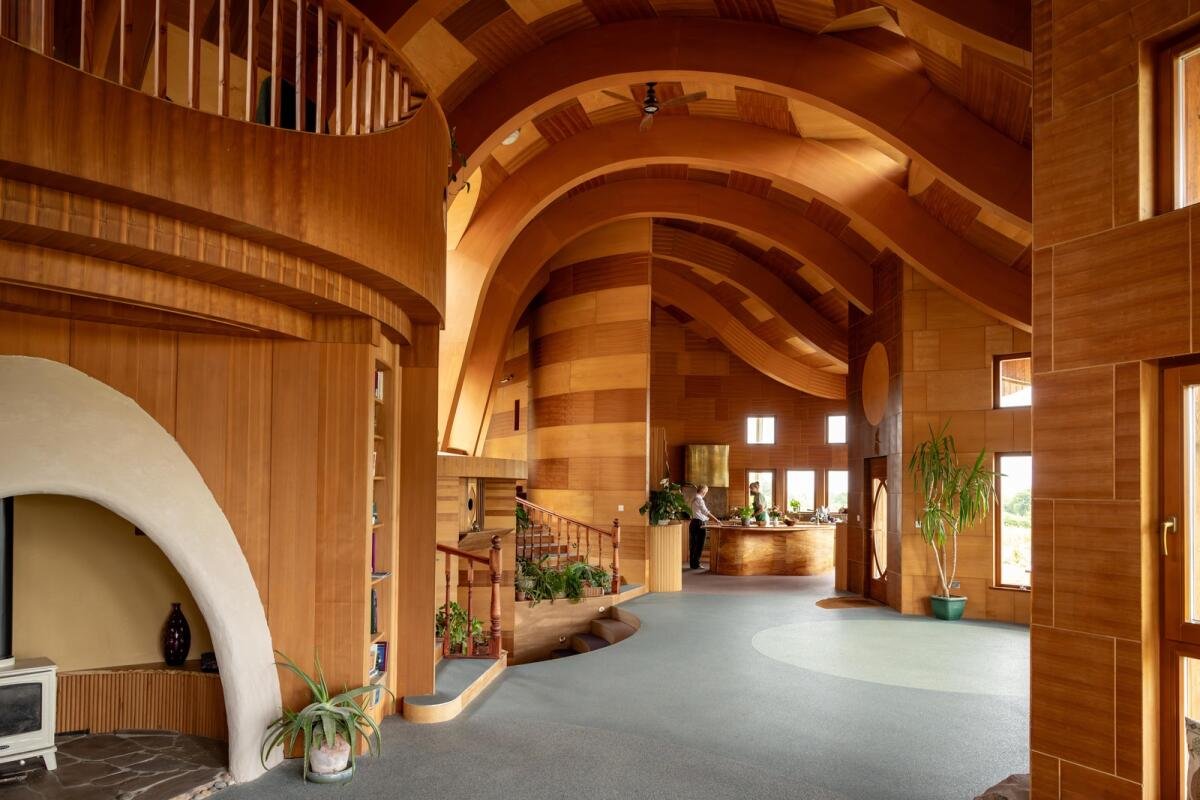
Arunachala offers day experiences as well as residential stays. Picture: Johnny Savage
Located just outside Mountrath, Arunachala is rooted in ayurveda,the ancient Indian system of holistic health. The practice centres on maintaining balance by understanding an individual’s mind-body constitution, or prakriti, and tailoring food, lifestyle and routines accordingly.
Proponents of ayurveda believe that each person’s prakriti is shaped by three doshas – vata (air and ether), pitta (fire and water) and lapha (earth and water) – which influence their physical, mental and emotional traits.
At Arunachala, offerings include ayurvedic assessments, personalised treatments, meals, yoga and meditation, with prices starting from €250 for a day experience and extending to longer residential stays of up to 28 nights.
While a handful of Irish retreats incorporate ayurveda, Arunachala is currently the only centre offering a full panchakarma programme, a deep therapeutic process designed to restore balance and reset the body’s baseline for long-term health.
McDermott completed a 40-day panchakarma retreat in Tamil Nadu, an experience he says unlocked something profound within him – an inner stillness he frequently refers to during our interview as “the silence at the butt end of my heart”.
What stirred such a fascination for ayurveda? “The mysteries and the meaning of life led me to India,” he says.” There is immense power in ayurveda, and a great self-awareness that comes with it.”
His vision was always to bring panchakarma back to Ireland, but first, McDermott had a few more of his reincarnations to tend to.
Farmyards to ashrams
McDermott’s background in tillage farming gave him a sharp eye for land purchasing. At 23, he bought 26 acres of his family’s farm; by his mid-twenties, he had amassed 75 acres locally, alongside a further 400 acres rented.In 1975, aged 25, he sold the 75 acres and purchased a Georgian house and 227 acres in Edenderry in Co Offaly. A subsequent spike in interest rates – to 21 per cent, with an additional six per cent surcharge – left him €600,000 in debt.
“It was the most traumatic time,” he says. “I can reflect on it now with the grace of time, but I was completely broke. It taught me how fortuitous, or not, timing can be.”
He sold the land and later the machinery, which triggered his idea for farm machinery trading. “Another reincarnation,” he says, smiling, as he tops up his fennel tea from a pot on the coffee table.
He ran the business from Tullamore for a decade before selling the site and stock. “I went from being €600,000 in debt to making it back exactly. I refuse to believe in coincidences,” he says.
Around that time, despite “resolutely” stepping away from farming, he purchased land in Ukraine and Estonia. The former he recently sold and the latter he still operates today.
Keeping track of McDermott’s chronology is like keeping track of a cat’s varied and abundantly full nine lives, something he quickly reiterates by telling me with a revealing enthusiasm that “we haven’t even touched on Beech Park”.
In 1995, McDermott and his late wife Mary bought the 18th-century Beech Park House on 64 acres in Clonsilla in Dublin, a property once owned by the Shackleton family. It sold for an estimated £700,000 and was reported as the deal of the decade at the time.
The land was zoned for agricultural use, and there the McDermotts raised their family of five and Neil established his construction business. Last September, he sold the 11-bedroom period house for €4.32 million to the neighbouring Luttrellstown Estate, owned by John Magnier and JP McManus.
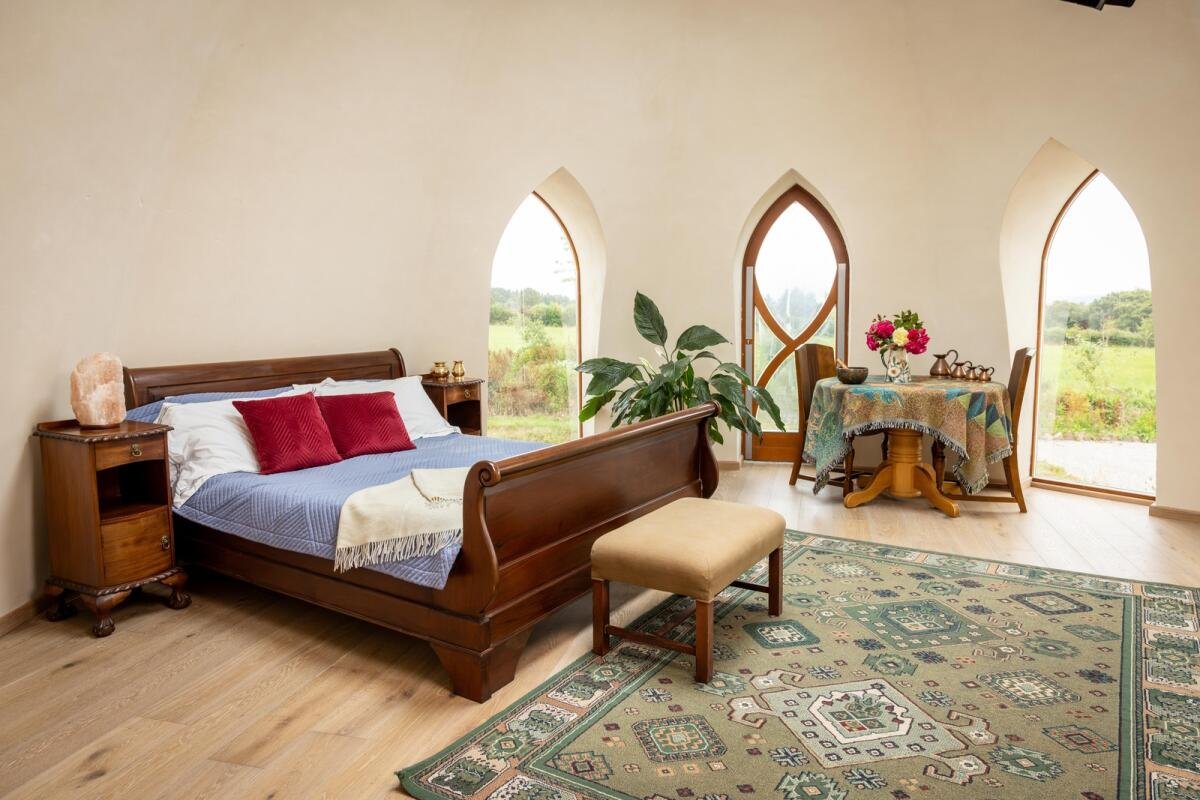
A bedroom at Arunachala. Picture: Johnny Savage
“It was the right time to pass Beech Park to its next custodian. I was travelling constantly between there and Laois managing the work on Arunachala, and I’d spent enough of my life on the road,” McDermott says, referencing his earlier years attending evening classes at the School of Philosophy and Economic Science in Dublin.
“It was a tough decision to make. The house held a lot of meaning for the family. It was also beautifully designed by Francis Johnston using the golden ratio – the same proportion seen in Leonardo da Vinci’s Vitruvian Man.”
Open hearts
There is barely a straight line to be found in the five-storey Arunachala, with highlights such as an undulating curved roofline; wide, winding staircases; and dome-shaped rooms all designed according to the golden ratio.
Originally designed in 2010 by bio-architects Michael and Heather Rice as a family home and architectural school at an estimated cost of €1.2 million, the 10,000 square foot property was acquired by McDermott in 2023 for €461,000 following a competitive bidding process.
Since then, he has invested more than €3.5 million completing the build, acquiring additional land and fitting out the interiors.
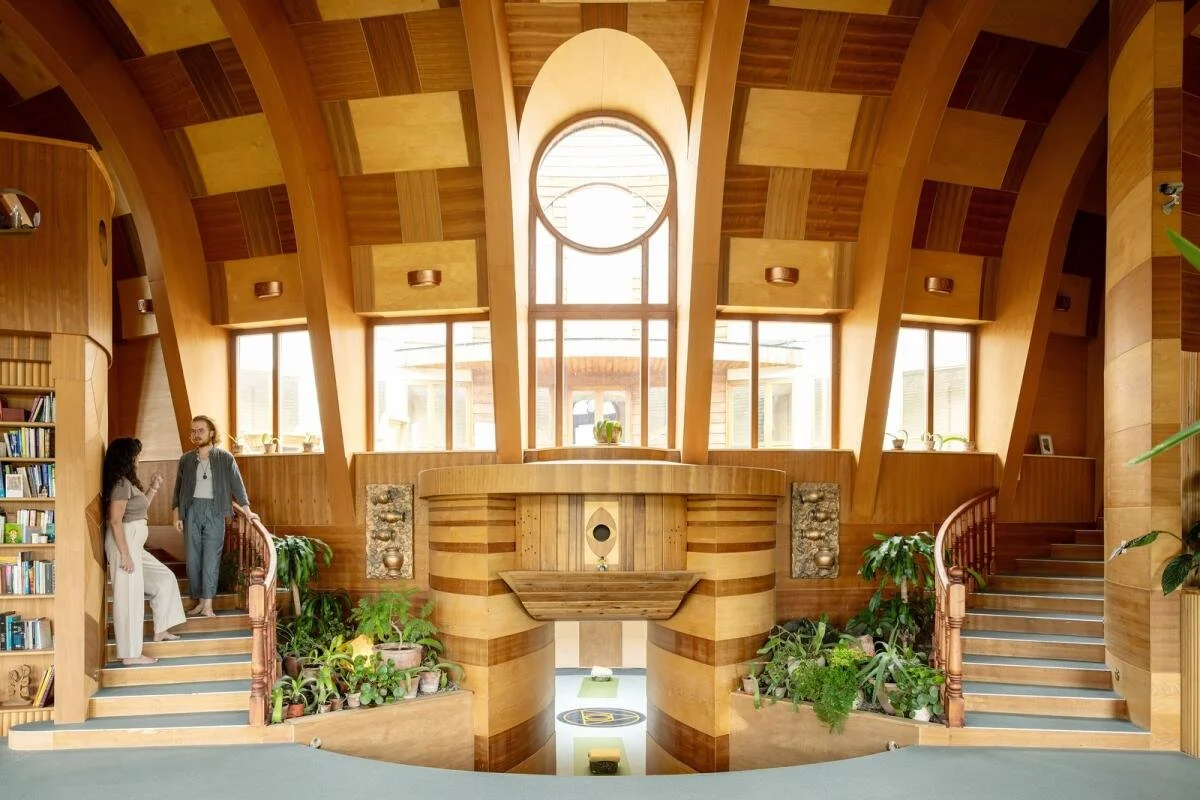
There is barely a straight line to be found in the five-storey Arunachala. Picture: Johnny Savage
In its first year, Arunachala has attracted guests from all over the country, some familiar with ayurveda, others entirely new to it. Visitors present with a range of concerns, from post-surgical recovery, to stress and burnout, the latter of which McDermott sees as emblematic of the always-on culture of the Western world.
While the pricing positions the centre at the premium end of the market, he says it reflects both the facilities and the specialist expertise involved, with plans to expand the team by recruiting additional therapists from India.
Most will wonder, I suspect, if there is a big enough domestic market to sustain such an ambitious venture.
“People are far more aware now,” he says. “When I was a 40-year-old farmer travelling to an ashram in India, people thought I was mad. Now, there's a real shift. People recognise there’s more to discover about themselves, if they’re willing to go there.”
It’s on that sentiment that Arunachala is predicated on, McDermott says. “All I ask of guests is to come with an open mind and the heart and will to help themselves. Everything else will follow.”
Trudy Feenane, July 24, 2026